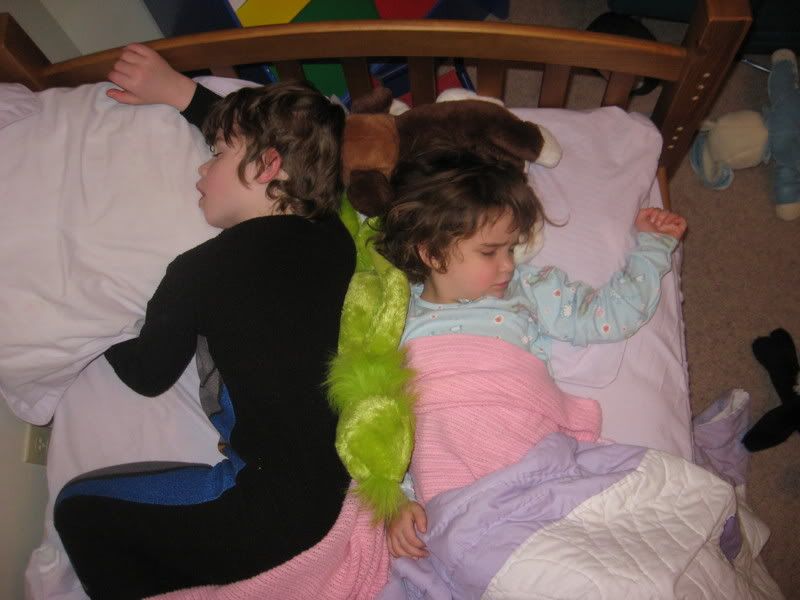
So yesterday evening was my big “day”. I had the opportunity to share “my story” with Minnesota state legislators, or more correctly “Gracie’s story” in regards to losing her secondary Medicaid coverage beginning January 2008 because our income will no longer qualify her for coverage.
Legislators in attendance were Larry Haws, Larry Hosch, Tarryl Clark, Steve Gottwalt, and Dan Severson. Other local elected officials that attended were Stearns County Commissioner Dewayne Mareck and Saint Cloud City Council member Bob Johnson.
You can read more about this town forum here.
The reporter of this article did not capture the message my story emphasized. I expressed the need to increase the income and asset standards for Medicaid so more people could qualify. Even with health coverage, I explained that because of chronic conditions in my family, we are forced into poverty to pay for these conditions and we are just barely over the 150% of poverty limit for Medicaid eligibility. I know that my story is not singular, but is just one of many stories like it. Families need the additional coverage and security that Medicaid allows, especially when their children have chronic health conditions. With the trend of higher co-pays, high premiums, and high deductibles, having commercial health insurance is less and less meaningful, especially for lower and middle income families.
After the forum, I was approached by several people to thank me for telling my story. I was also asked to tell my story at the capitol (Saint Paul, where all the MN state legislative “magic” happens) next year. Apparently there is a bill that has been written, but not passed, that will do just what my story emphasized the need for: Raise the income and asset limits for Medicaid eligibility.
I don’t know how often or how strongly I can emphasize the need for all of us to tell their story to legislators. Without the human perspective a personal story lends, legislation is cold and made without regard to the humans it affects. You better believe that your legislators are being inundated by powerful lobbying from corporations with the money to back their requests. But last night, from legislators, I heard over and over again how important the personal stories of their constituents are. If we do not tell our stories to them, if you do not share the victories and trials you face in social programs, how can our legislators truly make informed choices in their votes?
Wednesday, December 12, 2007


Tuesday, December 11, 2007
Sandis and Self-Advocacy
Sandis has ideas about the services he is receiving in the school and the community. If something isn’t working well in school, he has an idea about why it isn’t going well. He may also have a solution. Sandis has thoughts and ideas and feelings about his life and all of his experiences and the people who work with Sandis need to make a conscious effort to find out what those thoughts, ideas, and feelings are. This will create a higher effectiveness when working with Sandis.
It sounds so simple. But how often when dealing with an issue with Sandis’s IEP have I asked Sandis what he thinks I should do? Not that often. Sadly.
So this time around, I decided to change that premise. I spent about an hour talking to Sandis about all sorts of things that we are going to talk about in the IEP meeting. I wrote down my questions, and more importantly I wrote down his answers word-for-word.
As a result of this communication with Sandis, the recipient of services, he and I came up with some pretty nifty ideas which are based on what he perceives his needs to be, not what professionals perceive his needs to be (although basically, he is spot-on). A few of these ideas are:
1. Offer gum, don’t just make it available, but offer it regularly. Sandis listens better with gum.
2. Remind Sandis to hurry up at lunch so he doesn’t lose valuable outside time.
3. Let Sandis take a “buddy” with him when he does his sensory diet.
4. Sandis has problems listening during math and paying attention because he already knows what they are going over. He isn’t being challenged in math, and needs more challenge to keep his attention.
5. Assign Sandis jobs in the classroom which will utilize his desire to be a helper and at the same time get him out of his desk and moving around the classroom.
6. Have Sandis help other students with reading.
7. Always have a helper for Sandis in music and gym because he really needs help in those classes and doesn’t like to get in trouble.
What is so cool about this is these ideas are a result of Sandis talking about his needs and his reasons for different behaviors. He was very up front about sometimes needing a helper, and he was also very up front about not liking being in trouble. He also emphasized over and over and over about how good of a helper he is. And ya know, it kind of does take a kid telling you “I don’t listen because I know it already” to realize that misbehavior in math has more to do with boredom than sensory over- or under-stimulation.
The lesson? Sometimes our most valuable resource in regards to making services in the community and at school work is the recipient of those services. I think the fancy word for this is person-centered-planning.
It sounds so simple. But how often when dealing with an issue with Sandis’s IEP have I asked Sandis what he thinks I should do? Not that often. Sadly.
So this time around, I decided to change that premise. I spent about an hour talking to Sandis about all sorts of things that we are going to talk about in the IEP meeting. I wrote down my questions, and more importantly I wrote down his answers word-for-word.
As a result of this communication with Sandis, the recipient of services, he and I came up with some pretty nifty ideas which are based on what he perceives his needs to be, not what professionals perceive his needs to be (although basically, he is spot-on). A few of these ideas are:
1. Offer gum, don’t just make it available, but offer it regularly. Sandis listens better with gum.
2. Remind Sandis to hurry up at lunch so he doesn’t lose valuable outside time.
3. Let Sandis take a “buddy” with him when he does his sensory diet.
4. Sandis has problems listening during math and paying attention because he already knows what they are going over. He isn’t being challenged in math, and needs more challenge to keep his attention.
5. Assign Sandis jobs in the classroom which will utilize his desire to be a helper and at the same time get him out of his desk and moving around the classroom.
6. Have Sandis help other students with reading.
7. Always have a helper for Sandis in music and gym because he really needs help in those classes and doesn’t like to get in trouble.
What is so cool about this is these ideas are a result of Sandis talking about his needs and his reasons for different behaviors. He was very up front about sometimes needing a helper, and he was also very up front about not liking being in trouble. He also emphasized over and over and over about how good of a helper he is. And ya know, it kind of does take a kid telling you “I don’t listen because I know it already” to realize that misbehavior in math has more to do with boredom than sensory over- or under-stimulation.
The lesson? Sometimes our most valuable resource in regards to making services in the community and at school work is the recipient of those services. I think the fancy word for this is person-centered-planning.
Monday, December 10, 2007
I'm Fairly Popular in These Parts
And I tend to get a lot of letters published in the paper.
Check it out! There isn't as many comments this go around, but of course, I did get the complimentary crabasses to respond.
Check it out! There isn't as many comments this go around, but of course, I did get the complimentary crabasses to respond.
Friday, December 07, 2007
Is Health Care a Right or a Privilege Reserved for the Wealthy?
Article 25.
(1) Everyone has the right to a standard of living adequate for the health and well-being of himself and of his family, including food, clothing, housing and medical care and necessary social services, and the right to security in the event of unemployment, sickness, disability, widowhood, old age or other lack of livelihood in circumstances beyond his control.
This is pulled from the Universal Declaration of Human Rights, which was created in 1948.
On December 10, 1948 the General Assembly of the United Nations adopted and proclaimed the Universal Declaration of Human Rights the full text of which appears in the following pages. Following this historic act the Assembly called upon all Member countries to publicize the text of the Declaration and "to cause it to be disseminated, displayed, read and expounded principally in schools and other educational institutions, without distinction based on the political status of countries or territories."
I have a small booklet, which I received my first month at Partners, which has these very same rights printed in it. Why have we, as a nation, drifted away from distributing to our nation what at one point we agreed were fundamental rights of all people? Could it be, that perhaps, we don’t want people to know what their rights really are?
I understand this document is not the Constitution, and we as a nation are governed under the ideas and basic rights outlined in the Constitution. But at some point, more specifically, in 1948, our nation agreed also that the above rights were the basic rights of all people. The Universal Declaration of Human Rights was intended to be meaningful to all countries and in all societies. When did we lose our way in this regard?
I hope you take a few minutes out of your day to read this entire declaration.
(1) Everyone has the right to a standard of living adequate for the health and well-being of himself and of his family, including food, clothing, housing and medical care and necessary social services, and the right to security in the event of unemployment, sickness, disability, widowhood, old age or other lack of livelihood in circumstances beyond his control.
This is pulled from the Universal Declaration of Human Rights, which was created in 1948.
On December 10, 1948 the General Assembly of the United Nations adopted and proclaimed the Universal Declaration of Human Rights the full text of which appears in the following pages. Following this historic act the Assembly called upon all Member countries to publicize the text of the Declaration and "to cause it to be disseminated, displayed, read and expounded principally in schools and other educational institutions, without distinction based on the political status of countries or territories."
I have a small booklet, which I received my first month at Partners, which has these very same rights printed in it. Why have we, as a nation, drifted away from distributing to our nation what at one point we agreed were fundamental rights of all people? Could it be, that perhaps, we don’t want people to know what their rights really are?
I understand this document is not the Constitution, and we as a nation are governed under the ideas and basic rights outlined in the Constitution. But at some point, more specifically, in 1948, our nation agreed also that the above rights were the basic rights of all people. The Universal Declaration of Human Rights was intended to be meaningful to all countries and in all societies. When did we lose our way in this regard?
I hope you take a few minutes out of your day to read this entire declaration.
Thursday, December 06, 2007
On the DRA
I took a walk on my treadmill yesterday, and meanwhile afforded myself the opportunity to read a report on the DRA.
No. Not the NRA. The DRA.
I’m sure you’ve heard mention of the DRA here and there, and I’m sure the mention had all sorts of positive connotations. DRA = Deficit Reduction Act.
In this time of war, reducing deficits caused by a less-than-thrifty-in-regards-to-war-giddy President (notice I still use a CAPITAL “P”) is understandably a hot topic. We’ve borrowed our children’s and grandchildren’s futures to fund this war on “something but we aren’t quite sure what” so it makes sense that in an attempt to remedy this we create ways to reduce this deficit one way or another.
One way or another.
Back on Topic. So I was reading this Congressional Study on the DRA and I started to sweat. Not necessarily from my aerobic walking pace but more from a gut-wrenching rising fear.
Ever hear of cost-sharing? How about cost-sharing in regards to health insurance? (Certainly a hot topic among Republicans who seem to assume that all poor people are irrefutably irresponsible with their funds as evidenced by our poverty!) So how would you figure on cost-sharing for health insurance in the Medicaid sphere? As in shoving additional expenses on our most impoverished and vulnerable citizens and breaking their bank account (or more accurately lack of bank account) all for the benefit of a savings in the “several billion dollars” area for the good ‘ol Federal G’.
That extra $3 co-pay for their prescription drug will go a long way to save the government money namely why? Because many will “opt out” of their prescription because they do not know (nor is it a priority to have it be known) that they “DON’T HAVE TO PAY” the co-pay to receive the prescription. If they do pay, they literally are only paying back a portion of the federal welfare they are already receiving because they are either poor or disabled. How fucked up is that? Nothing screams USA quite like welfare charge-backs!
Of course, if you are a Medicaid recipient and you are not under the age of 21 or pregnant (sorry guys), you know this cost-sharing is already in effect. Did you also know that future plans in the DRA would remove that “DON’T HAVE TO PAY” clause, meaning that providers can REFUSE service or medication if the patient does not have the $3 to pay the co-pay? Perhaps, you say, this is no big deal. What is $3? Really?
If you are a recipient of SSI, $3 is a portion of your $637 monthly income which is expected to pay for:
1. Housing
2. Utilities
3. Transportation
4. Clothing
5. Food (in some cases)
6. Anything else you require to live and function independently
Work your budget on $637 a month and THEN you will begin to realize the importance of that $3 and the ridiculousness and inhumanity that this imposes.
This doesn’t even begin to address how the DRA will really “get you where it hurts” when you are elderly. Don’t even think about the repercussions if you are elderly AND disabled.
I am going to see about scanning in this report and posting it up here for review by loyal readers who are in for some dry yet frightening reading.
Ever feel like someone has pulled the wool over your eyes?
I do.
Want to read the report I read? I found it online. Go here and read it for yourself.
No. Not the NRA. The DRA.
I’m sure you’ve heard mention of the DRA here and there, and I’m sure the mention had all sorts of positive connotations. DRA = Deficit Reduction Act.
In this time of war, reducing deficits caused by a less-than-thrifty-in-regards-to-war-giddy President (notice I still use a CAPITAL “P”) is understandably a hot topic. We’ve borrowed our children’s and grandchildren’s futures to fund this war on “something but we aren’t quite sure what” so it makes sense that in an attempt to remedy this we create ways to reduce this deficit one way or another.
One way or another.
Back on Topic. So I was reading this Congressional Study on the DRA and I started to sweat. Not necessarily from my aerobic walking pace but more from a gut-wrenching rising fear.
Ever hear of cost-sharing? How about cost-sharing in regards to health insurance? (Certainly a hot topic among Republicans who seem to assume that all poor people are irrefutably irresponsible with their funds as evidenced by our poverty!) So how would you figure on cost-sharing for health insurance in the Medicaid sphere? As in shoving additional expenses on our most impoverished and vulnerable citizens and breaking their bank account (or more accurately lack of bank account) all for the benefit of a savings in the “several billion dollars” area for the good ‘ol Federal G’.
That extra $3 co-pay for their prescription drug will go a long way to save the government money namely why? Because many will “opt out” of their prescription because they do not know (nor is it a priority to have it be known) that they “DON’T HAVE TO PAY” the co-pay to receive the prescription. If they do pay, they literally are only paying back a portion of the federal welfare they are already receiving because they are either poor or disabled. How fucked up is that? Nothing screams USA quite like welfare charge-backs!
Of course, if you are a Medicaid recipient and you are not under the age of 21 or pregnant (sorry guys), you know this cost-sharing is already in effect. Did you also know that future plans in the DRA would remove that “DON’T HAVE TO PAY” clause, meaning that providers can REFUSE service or medication if the patient does not have the $3 to pay the co-pay? Perhaps, you say, this is no big deal. What is $3? Really?
If you are a recipient of SSI, $3 is a portion of your $637 monthly income which is expected to pay for:
1. Housing
2. Utilities
3. Transportation
4. Clothing
5. Food (in some cases)
6. Anything else you require to live and function independently
Work your budget on $637 a month and THEN you will begin to realize the importance of that $3 and the ridiculousness and inhumanity that this imposes.
This doesn’t even begin to address how the DRA will really “get you where it hurts” when you are elderly. Don’t even think about the repercussions if you are elderly AND disabled.
I am going to see about scanning in this report and posting it up here for review by loyal readers who are in for some dry yet frightening reading.
Ever feel like someone has pulled the wool over your eyes?
I do.
Want to read the report I read? I found it online. Go here and read it for yourself.
Tuesday, December 04, 2007
Thursday, November 29, 2007
Death & Legislation
Yesterday was a day, and at the end of the day, I was thankful that I left my job WITH a job.
I have a couple of things I need to talk about today. The first is this: Recently a man was arrested for suspicion of drunk driving. The man refused a breathalyzer so he was arrested and put on a 48 hour hold in a detention center. The man was brain dead and unable to be revived the next day in his cell. The death is unusual, but there is more, which I think you will find interesting. This man had diabetes. When this man was detained police officials asked him if he would like to test his blood sugar, yet he declined. They did not pursue the matter further. Later the next day the man was found dead and the reason for death is untreated diabetes.
The uneducated person may say, “He declined to check his blood sugar, this is what he gets!” It is what he got, I suppose. But ask yourself this. If for whatever reason one day you are detained by officials and at the time of your detention, what you truly need is a hospitalization, would you rather “Get what is your due” or would you rather that the officials value your life enough to provide you with appropriate medical care? Is the sentence more important than an individual’s life?
The very fact that the police officials asked this man if he would like to check his blood sugar indicates that they knew of his diabetes. Individuals with diabetes know that ingestion of alcohol can cause severe and prolonged low blood sugars, which may make an individual unable to care for their needs. This in and of itself is life-threatening. Add to that, assuming the gentleman that died is a type 1 diabetic, he will not live very long without insulin and a full 24 hours without insulin could indeed be a death sentence. Another twist, sickening as it is, is this man’s mother had been in contact with detention facility officials asking them to treat this man’s diabetes. Is drunk driving really punishable by death? Apparently only for diabetics. I found this story in the printed Saint Cloud Times today. I was not able to find it online. If you find this story online, will you please send me the link?
The end result of this is that this detention facility, the main jail in Ramsey County (Saint Paul), will now have 24-hour medical care. Is this appropriate recompense? I really don’t know. What do you think? I think more appropriately there needs to be a protocol that is followed when any person with diabetes is admitted to the facility.
The last bit of news is that the Saint Cloud School District (#742) is having a town legislative forum on Tuesday December 4th at 6:30pm at Apollo High School. You better believe I am going to be there, and it just so happens that my Tuesday night is free next week. I’m afraid that if I don’t go, there won’t be any parents yelling about the importance of our special education supports. Cuts in special education are not appropriate by any means. Call me the guardian angel of Spec. Ed. Funds (this is me being grandiose).
I have a couple of things I need to talk about today. The first is this: Recently a man was arrested for suspicion of drunk driving. The man refused a breathalyzer so he was arrested and put on a 48 hour hold in a detention center. The man was brain dead and unable to be revived the next day in his cell. The death is unusual, but there is more, which I think you will find interesting. This man had diabetes. When this man was detained police officials asked him if he would like to test his blood sugar, yet he declined. They did not pursue the matter further. Later the next day the man was found dead and the reason for death is untreated diabetes.
The uneducated person may say, “He declined to check his blood sugar, this is what he gets!” It is what he got, I suppose. But ask yourself this. If for whatever reason one day you are detained by officials and at the time of your detention, what you truly need is a hospitalization, would you rather “Get what is your due” or would you rather that the officials value your life enough to provide you with appropriate medical care? Is the sentence more important than an individual’s life?
The very fact that the police officials asked this man if he would like to check his blood sugar indicates that they knew of his diabetes. Individuals with diabetes know that ingestion of alcohol can cause severe and prolonged low blood sugars, which may make an individual unable to care for their needs. This in and of itself is life-threatening. Add to that, assuming the gentleman that died is a type 1 diabetic, he will not live very long without insulin and a full 24 hours without insulin could indeed be a death sentence. Another twist, sickening as it is, is this man’s mother had been in contact with detention facility officials asking them to treat this man’s diabetes. Is drunk driving really punishable by death? Apparently only for diabetics. I found this story in the printed Saint Cloud Times today. I was not able to find it online. If you find this story online, will you please send me the link?
The end result of this is that this detention facility, the main jail in Ramsey County (Saint Paul), will now have 24-hour medical care. Is this appropriate recompense? I really don’t know. What do you think? I think more appropriately there needs to be a protocol that is followed when any person with diabetes is admitted to the facility.
The last bit of news is that the Saint Cloud School District (#742) is having a town legislative forum on Tuesday December 4th at 6:30pm at Apollo High School. You better believe I am going to be there, and it just so happens that my Tuesday night is free next week. I’m afraid that if I don’t go, there won’t be any parents yelling about the importance of our special education supports. Cuts in special education are not appropriate by any means. Call me the guardian angel of Spec. Ed. Funds (this is me being grandiose).
Subscribe to:
Posts (Atom)