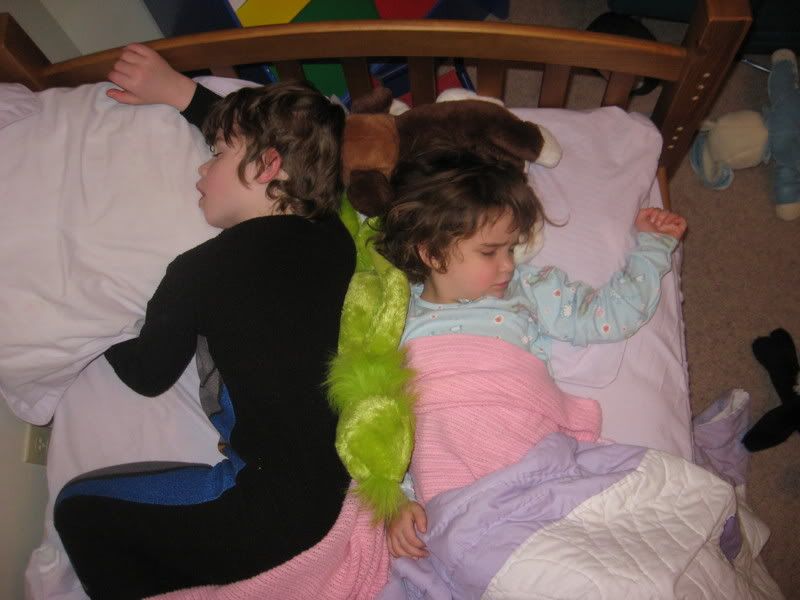
Dear President Bush,
I am sending this email to urge you to sign the SCHIPS bill that was
passed by overwhelming majority in the Senate and House this past week.
I am a mother of two special needs children. One child is a recipient of
SSI and Medical Assistance. His name is Sandis, he is seven years old,
and he has an autism spectrum disorder. My daughter, Gracie, is age four
and has a diagnosis of mild cerebral palsy, type 1 diabetes, and asthma.
She currently receives Medicaid for low income famlies as she is not
disabled enough to receive SSI (nor should she!)
If you do not sign this bill, my daughter will lose eligibility for her
Medicaid next year when I receive my annual raise. Gracie has primary
insurance through my employer, but should she lose the Medicaid, I would
no longer be able to afford to provide her with very basic therapies she
currently receives which allow her to be a high functioning young child
despite the limitations of her cerebral palsy.
I am an employed tax-payer. I do not qualify for many welfare benefits,
outside of my son's SSI and MA and my daughter's Medicaid (which she
receives because I fall less than $200 dollars under the annual allowable
income to qualify).
Should you choose to not sign this bill, you are taking away my daughter's
basic medical support system.
And for what?
We should encourage families to be self sufficient, and we should
encourage non-working families to work, but what encouragement is there
when working families cannot care for their children medically (with or
without disability?) Should my daughter lose her Medicaid, I would have
three options:
1. Stop her occupational and physical therapy which trains her body,
weakened by cerebral palsy, to do basic day-to-day tasks.
2. Quit my job and apply for a job that pays less, so I can qualify for more federal benefits and Gracie would continue to have health coverage so her many
therapies would still be covered at an affordable rate.
3. Force my family into debt and poverty in order to pay for therapies I cannot afford. (My daughter's therapies, copays and %'s, are approximately $90 a week
after my insurance has paid their portion.)
I am one family.
You can choose to help the children of your nation, or you can choose to look the other way.
Please be a hero.
Sincerely,
Sarah Rittmann
Friday, September 28, 2007


The Implications of the Word Disability
In what seems like long ago, while applying for SSI for my son, I struggled with the implications of the word disability. I struggled with labeling my son and therein limiting my son. I felt as though if I stated that my son was disabled, I was taking away his rights to accomplish whatever he may dream of. I felt as though I would be limiting my son to the preconceived notions concerning what a child with his specific disability may or may not be capable of.
Back then, the word disability was all about limits. But I’m not afraid to use that word anymore.
The word disability may seem limiting. Labeling someone with a disability may seem limiting. But disability advocacy is all about opening doors and removing those limitations. My child who has a disability has the same rights as a child without a disability. These things include:
1.) Attend school at a public school with other kids that don’t have disabilities (with whatever supports he needs to accomplish that)
2.) Choose who he wants to befriend
3.) Participate in extracurricular activities (even if he requires additional supports to do so)
For so long children with disabilities were excluded from basic things like the above-listed. The behaviors my son displayed in a public-school setting before supports would have been enough to place him in a segregated school setting that would have taken away all of the above three basic rights. In addition to the rights he has now, disability advocacy is opening doors and taking away limitations for my child as he grows into an adult.
When my son is an adult he can expect to:
1) Choose what he wants to do for a living (not just any job the community thrusts at him)
2) Choose where and in what type of setting he wants to live
3) Choose who his doctors are
4) Choose who his friends are
5) Choose what he wants to spend his money on
Disability advocacy is all about choices and opportunities, and making sure children and adults with disabilities have the same choices and opportunities you and I would have.
Under that pretense, the “word” disability seems a whole lot less limiting.
On a political note, the SCHIPS bill is up for vote in the Senate today. This would raise the annual allowable family income for a family of four to qualify for State Healthcare for their children from around $42,000 to $62,000. Do you know any families that this bill, if passed, would help? I guarantee you do. Call your Senator today and urge them to vote yes for this bill. And if you don’t know who your Senator is or what the phone number is? Go here.
I dare you to take action to make a positive change for the families in your community. Go on. Do it.
(Edit: Day late, dollar short, they voted yesterday....Good news though, Senate voted yes with enough of a majority to override the expected presidential veto.....And ya, I called yesterday. Please visit the sight though, there are other great opportunities to be an advocate for families, and you might be surprised to find an opportunity to advocate for youself (see the ADA Restoration Act, and ask yourself how it affects the relationship between employers and their employees with diabetes).
Thursday, September 27, 2007
Messages From Bob
Bob left me a message on my cell phone the other day:
“Sarah, I’ve been thinking about this advocacy thing you’ve been doing and I think maybe it is a good thing. Maybe you are strong for a reason. (He means I’m a loud-mouth). People who are weak need someone who is strong to speak for them. “
This simple admission from Bob was a wonderful affirmation for me. My priorities are changing lately. I’m beginning to see, more and more, why it is important for me to not only advocate for my children, but to be involved in my community and the politics that surround disabilities. If I don’t take a step forward and try and facilitate change, what will my children be grandfathered into? What will your children be grandfathered into? What will you and I be grandfathered into as we age and enter into the fundamentally disabling process of getting older?
I’ve realized, in no uncertain terms, that I have a voice concerning disability rights. I believe that it is my personal responsibility to ensure my voice is heard.
I have feared for so long that my history with drug treatment combined with my children placed in foster care for the duration of that treatment, excluded my voice. I was afraid of my past, and the repercussions my past could have should I choose to be active in my community. Last night, as I completed my LifeLine homework for next months’ Partners in Policymaking weekend, I chose to not be afraid. I chose to embrace myself, including my past. I chose to cast out shame.
Life, sometimes, makes it easy to live in fear. Fear makes it easy to refute responsibility. I refuse to provide a resting-place for fear. I have the capacity to help, and shedding my fear allows me to do so.
Saturday, September 22, 2007
Partners in PolicyMaking, Weekend One
I came to the realization, at some point this morning, that I have chosen to be a part of a monumentally huge and time-consuming endeavor. I have chosen this.
The sheer volume of paperwork we are expected to rifle through in the next month is madness in and of itself. The community work and the personal steps we are expected to take in the next several months is more madness (how can one person do so much?). The expectations of graduates after this 9-month mania is even more madness.
I did not expect what I committed myself to. I did not expect that this will be what it is.
And you know what? I can't imagine immersing myelf in something that is more related to my life, my passions, my joys, my fears, and my values than what Partners in Policymaking is teaching. I never imagined that giving so much, knowing that I am going to give more than I ever have before, would be exactly what this old soul needs.
Enough about me. In my class, I met some amazing parents. And even cooler (sorry parents), I met some amazing adults who themselves live with developmental disabilities. I saw what could be my son's future, my daughter's future. I discovered a new direction that I never realized was important before, and really now I wonder how the concept escaped me. This elusive concept? Self-Advocacy. Not so elusive at all eh?
I don't believe I can adequately express my feelings right now. I'm struggling with sitting as I over-extended myself this weekend in my two-week post back surgery state. For now I will rest, and later, perhaps I will gather my thoughts enough to compose a post that is more focused and composed in regards to this weekend.
In final, I have to say....I may not be one for that whole fate thing, or having a certain calling....But never have things felt more right and more in keeping with my spirit, my talents, my joys, my fears, my everything than this weekend felt. The feeling in regards to this is so powerful that I'd like to say it shakes my very soul, but as that may be more of a cliche than an accurate description, perhaps I shall only say that tears have been welling in my eyes for close to two days now. I'm not quite sure if they are tears of joy, sorrow, entitlement, finality.....But things feel different. And I am quite certain that this, this Partners thing, is going to change my life.....
And I'm going to make sure that I'm not the only life it changes.....
Monday, September 17, 2007
On the Brevity of Things
I am awakened not suddenly but gradually by the pitter-patter tippy-toeing of three year old feet. I hear the soft padding of her toes, scissoring up and down the hall. She flits back and forth quickly and unevenly, tippy-tioes crossing one toe over the other. I turn over in bed, call out to the hall: "Gracie do you have to go potty?"
The pitter-patter stops. Resumes. A simpering yes bounces back from the hall, her whine and impatience reflected in her voice amdist the uneven fluttering of her footfalls.
"Well honey, just go potty!"
The pitter-patter hesitates. "Okay!" bounds back from the hall, followed by a flurry of pitter-patter followed by the squeak of the bathroom door.

This happened so many times. Bob and I used to giggle about it in the morning, giggle about the flurry of her activity late at night and the inability to register why she was prancing about so.
I imagine now, those times, when I hear her uneven foot-fall, and imagine I can see her gait in the soft sounds her toes make as they scamper about. Pitter-Patter, scissoring feet.
Sometimes the brevity of the words I deal with everyday amazes me. I wonder, in my darkest moments, how everything went so wrong. Autism, asthma, diabetes, and now cerebral palsy. They are all such heavy words, carrying with them so many loaded consequences and certain fears. The weight of these words can bury me, can bury my soul, my heart, my happiness.

I've spoken often on this blog about the importance of perspective. I live in an income-controlled community, also known as lower income housing. I live among adults who are disabled, and families that are literally disabled (parents who are disabled who have children who are disabled). I witness so much poverty and I wonder at it. I do not feel poor. Most of the families in my neighborhood are very poor. I ended up here because I can not afford a market-rate 3-bedroom townhome (1100-1200/month). Most other families move here because this is family housing that accepts section 8 vouchers. I love my home. I feel so blessed by the space we have now compared to our old 2-bedroom. We are even more blessed by the off-street courtyard between the buildings that is a huge area for all the neighborhood kids to play. I am astounded often that people who live in my neighborhood hate it. They hate the iffy neighbors, they hate the surrounding poverty, their time-saving dishwashers. This perplexes me. This home is such a nice step up from our old place. I realize how much happiness I have due to my perspective. I am choosing to love my home, my home in Saint Cloud. There are things I dislike about this area, but there are many more I love.
This too can be said about the brevity of those words I mentioned previously. The weight that is held by those words may also be diminished. I am given, every day and every moment, an opportunity to choose to not be buried, to choose to not be weighed down by the path that has been given to my family. And in many ways we are blessed. In many ways, depending on the day, my children's diagnoses are invisible, behind closed doors. They function, for the most part, like every other child. I am blessed with their health, and their joy, and their uniqueness. We are blessed as a family with challenges, just as we are blessed with day-after giggles as we discuss the pitter-patter footfalls of children from the night before.

Even now, I can hear the scissoring, pitter-patter of my little girl set high on her tippy-toes at 3 am. The fluttering of her feet could just as easily be the flapping of angel's wings.
Friday, September 14, 2007
The End of Another Diagnosis Journey

Today was Gracie's initial physiatrist appointment. For those of you who don't know, a physiatrist is a physical medicine doctor. Gracie was referred to the physical medicine doctor by her neurologist. Her neurologist felt that none of her symptoms were indicative of a neurological disorder but did feel they should be monitored by a physical medicine doctor to ensure that the most appropriate approach is being taken for her orthopaedic needs.
Gracie's physiatrist was very kind and listened very well. The end result today was a diagnosis of mild CP, or mild cerebral palsy. We will follow up with her physiatrist twice a year from here on out, but other than that, he does not have any recommendations. Her doctor told us that her CP qualifies as a movement disorder based upon hypotonia (low muscle tone) combined with joint laxity.
Gracie has progressed so far and gained so much strength, especially on her right side, since beginning physical therapy. Her physical therapy, as of today, will be discontinued, because of that fact. We will continue to use her Theratogs for up to three years, and as she grows the type of ankle and foot brace she uses will change to fit her needs.
Cerebral Palsy sounds like such a big thing, such a big terrible thing. For some people it really is, but for Gracie, it isn't. CP is the name for all of the muscle and joint oddities in her we've observed since birth. And really, most aren't very noticeable anymore. Nothing changes for her because of this diagnosis, except for an availability of more services should she need them.
A small part of me wants to shed a tear or two today. But then, an even bigger part of me feels that would be foolish. I pushed for a diagnosis because I knew, in my heart, that there was a diagnosis that fit her. I knew that everything put together had a name. And I was right. That name is cerebral palsy. And nothing, nothing much, changes because of it.
Wednesday, September 12, 2007
Chocolate Dreams

One of the many things I love about Bob is his silliness, and also his great ideas.

Last night his great idea was to feed the kids each a piece of chocolate while they were asleep. Imagine the two of us sneaking into darkened rooms prodding sleeping angels with gentle nudges and chocolate whispers.

This morning Sandis was not convinced that an actual chocolate feeding frenzy had occurred. Gracie remembered the entire thing. After careful examination of these pictures, Sandis, not being able to see any actual chocolate in his hands, still was not convinced.

I hope he at least dreamed of chocolate.

Subscribe to:
Posts (Atom)